


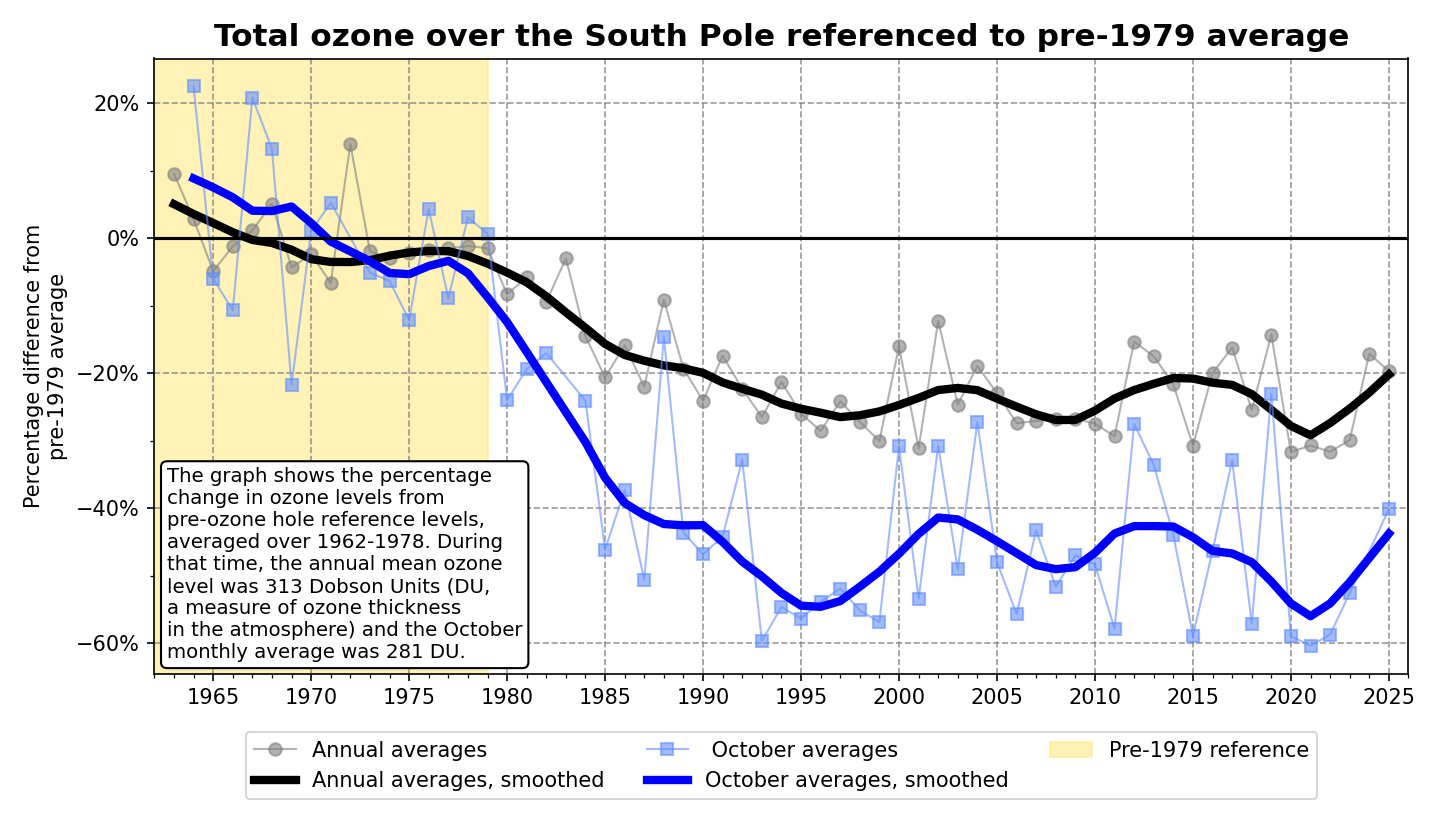
The image above shows changes in total column ozone measurements made annually each year and during the month of October, beginning in 1962, at the Amundsen Scott South Pole Station. The annual and monthly averages in the graph above are smoothed (thick line).
The average thickness of the ozone layer over the South Pole during the period between 1962 and 1973 is 313 Dobson Units (DU, a measure of the thickness of the total amount of ozone in a column of air from the Earth's surface to the edge of space) and 245 DU after 1979. 1979 is the year ozone thickness dropped below 220 DU, meeting the criteria for ozone hole conditions. 100 DU corresponds to a thickness of 1mm of pure ozone compressed to sea level pressure. If the ozone layer of thickness 245 DU was compressed to a layer of pure ozone at sea level, its thickness would be 2.45 millimeters thick, or about 2 and half stacked dimes. If the entire atmosphere was also compressed, it would be about 8 kilometers (5 miles) thick.
The ozone hole happens when the Earth’s protective ozone layer in the stratosphere above the South Pole begins to be destroyed by human-produced compounds that have been transported to the stratosphere. These compounds contain chlorine and bromine that are released and activated by sunlight. Because of the very cold temperatures found in the Antarctic winter stratosphere, icy polar stratospheric clouds form and radically enhance the reactions that destroy ozone. The Antarctic spring after the sun rises (September and October especially), creates the perfect conditions of clouds, sunlight that activate the chlorine and bromine to allow the ozone hole to form.
Total ozone levels vary from year to year because of changing meteorological conditions within the polar vortex, including the development of extremely low stratospheric temperatures during the Southern Hemisphere winter (from June-August) which leads to the formation of polar stratospheric clouds.
Variability in total ozone levels is driven not only by the amount of ozone depletion that occurs mostly in but also by the stability of the polar vortex during October, when the mixing of high ozone air masses from outside the vortex can increase total ozone.