The 2022 eruption of the Mauna Loa volcano cut off road access to the Mauna Loa Baseline Observatory. Construction on the temporary Mauna Loa Access road was completed on 26 March, 2026.
At this time, there is no site access for the general public to the Mauna Loa Observatory and NOAA has not yet established a public opening date. GML and scientific partners are working together to bring mission critical scientific projects back online. It is still unclear when utility infrastructure will be replaced and power re-established to the site.
We will provide another update as more information becomes available.
Media contact: Theo Stein at (303) 819-7409 or theo.stein@noaa.gov.
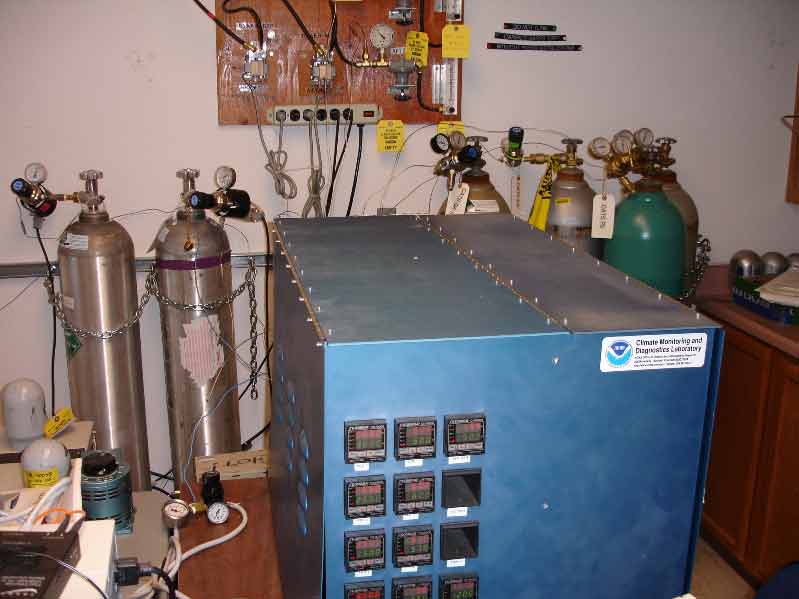
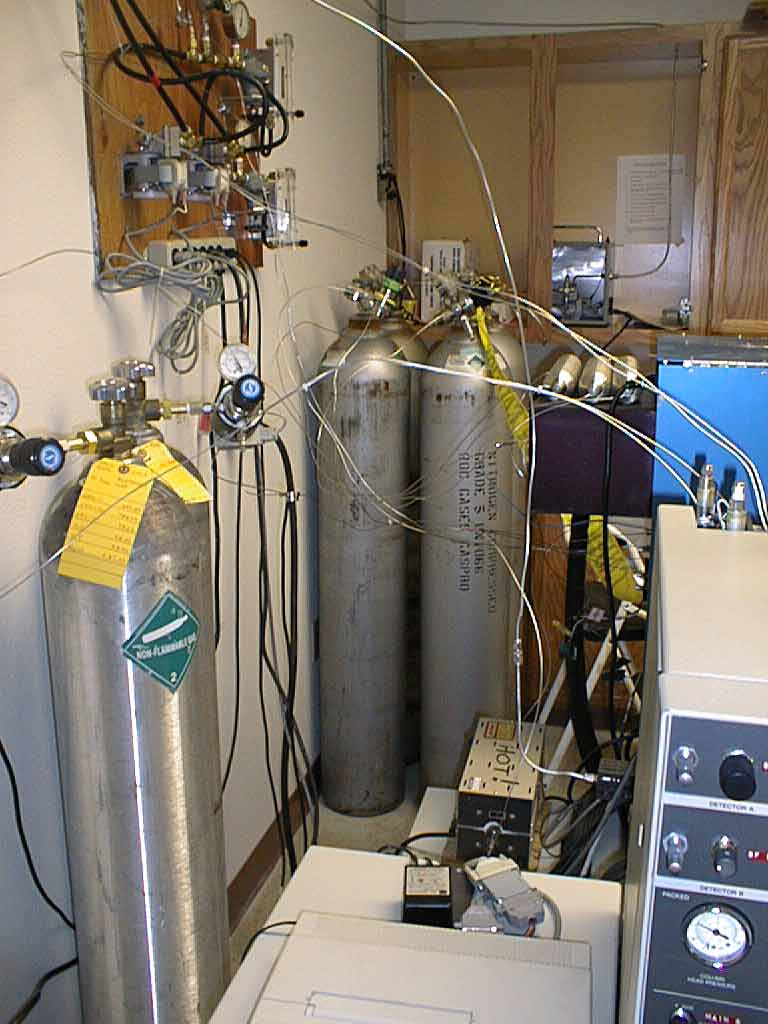
NOAA Chromatograph For Atmospheric Trace Species (CATS) Stealth GC
Organization(s):
 National Oceanic
and Atmospheric Administration (NOAA),
National Oceanic
and Atmospheric Administration (NOAA),
Global Monitoring Laboratory (GML)
What does this program measure?
The Mauna Loa Observatory CATS (Chromatograph for Atmospheric Trace Species) CATS program measures the following, where 'ppt' is parts-per-trillion, and 'ppb' is parts-per-billion.
| Category | Chemical | Chemical Formula | Units |
|---|---|---|---|
| Chlorofluorocarbons | Trichloro(mono)fluoromethane | CFC-11 (CCl3F) | ppt |
| Chlorofluorocarbons | Dichlorodifluoromethane | CFC-12 (CCl2F2) | ppt |
| Chlorofluorocarbons | Trichlorotrifluoroethane | CFC-113 (CCl2F-CClF2) |
ppt |
| Hydrochlorofluorocarbons | Chlorodifluoromethane | HCFC-22 (CHClF2) | ppt |
| Methyl Halides | Chloroform | CHCl3 | ppt |
| Methyl Halides | Methyl Bromide | CH3Br | ppt |
| Chlorinated Solvents | Carbon Tetrachloride | CCl4 | ppt |
| Chlorinated Solvents | Halon-1211 | CBrClF2 | ppt |
| Chlorinated Solvents | Methyl Chloride | CH3Cl | ppt |
| Other Measurements | Nitrous Oxide | N2O | ppb |
| Other Measurements | Methyl Chloroform | CH3CCl3 | ppt |
| Other Measurements | Carbonyl Sulfide | COS | ppt |
How does this program work?
Electron Capture Detection-Gas Chromatography is done continuously at MLO.
Why is this research important?
All of these gases are greenhouse gases. Chlorofluorocarbons (CFCs), Hydrochlorofluorocarbons (HCFCs), methyl halides (CH3Br and CH3Cl), and N2O deplete stratospheric ozone. Chlorinated solvents are involved in regional air quality.
Are there any trends in the data?
CFCs, CH3CCl3, CH3Br, and CCl4 are decreasing because of the Montreal Protocol. N2O, HCFCs, and HFCs are increasing.
What is it's role in global climate change?
All of these gases are greenhouse gases to a certain degree.
Comments and References
- Butler , J.H., J.W. Elkins, B.D. Hall, S.O. Cummings, and S.A. Montzka, A decrease in the growth rates of atmospheric halon concentrations, Nature, 359, 403-405, 1992.
- Butler, J.H., J.W. Elkins, T.M. Thompson, and K.B. Egan, Tropospheric and dissolved N 2O of the west Pacific and east Indian Oceans during the El Niño-Southern Oscillation event of 1987, J. Geophys. Res. , 94 (D12), 14865-14877, 1989.
- Dlugokencky, E.J., T. J. Conway, P. P. Tans, S. A. Montzka, and J. W. Elkins, Recent trends in greenhouse gases, in Sixth Symposium on Global Change Studies, pp. 202-204, 1995.
- Elkins, J.W., T.M. Thompson, T.H. Swanson, J.H. Butler, B.D. Hall, S.O. Cummings, D.A. Fisher, and A.G. Raffo, Decrease in the growth rates of atmospheric chlorofluorocarbons 11 and 12, Nature, 364 (August 26, 1993), 780-783, 1993.
- Montzka, S.A., J.H. Butler, R.C. Myers, T.M. Thompson, T.H. Swanson, A.D. Clarke, L.T. Lock, J.W. Elkins, Decline in the tropospheric abundance of halogen from halocarbons: Implications for stratospheric ozone depletion., Science, 272, 1318-1322, 1996.
Lead Investigator(s):
MLO Contact(s):
Aidan Colton
808-933-6965 (x233)
Paul Fukumura
808-933-6965 (x223)
Web Site(s)
http://gml.noaa.gov/hats
http://gml.noaa.gov/hats/insitu/cats/
Date Started
1977
Related Programs
Halocarbon Flasks
Cooperative Global Air Sampling
Greenhouse Gases
Photographs: