


Information
Home FAQ Project Goals Documentation Collaborators TutorialResults
Fluxes Observations Evaluation Visualization DownloadGet Involved
Suggestions E-mail List Contact UsResources
How to Cite Version History Glossary References Bibliography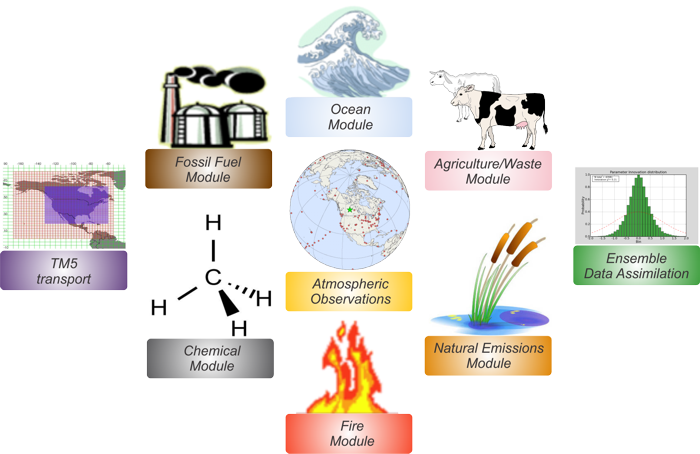
To learn more about a CarbonTracker component, click on one of the above images.
Or download the full PDF version for convenience.
Oceans
Introduction
The oceans play a relatively small role in the budget of atmospheric methane, contributing only ~2-3% of the global emissions (~10-15 TgCH4/yr). A significant portion of this is assumed to come from methane seeps in shallow coastal waters (~5 TgCH4/yr). In order for this to happen, the overlying water column must be shallow since methane is efficiently removed by aerobic microbial processes. This means that the water column must be shallow enough for bubbles to deliver methane directly to the air at the surface. Shallow coastal waters can be supersaturated in CH4, and may emit about 6 TgCH4/yr to the atmosphere, while the open ocean waters may add another 3 TgCH4/yr (Houweling et al., 1999; Lambert and Schmidt, 1993).
Detailed Description
Rhee et al. (2009) have suggested that global ocean methane emissions, excluding natural seeps, is much smaller than the ~9 TgCH4/yr we have used in this version of CarbonTracker-CH4; only about 0.6-1.2 TgCH4/yr. On the other hand, recent studies conducted in the coastal waters of the Eastern Siberian Arctic, hint at the possibility that a significant source of methane is sourced from methane bubbling of continental shelf sediments (Shakova et al., 2010). There is considerable uncertainty in the contribution of the ocean to atmospheric methane. To account for this in CarbonTracker-CH4 we decided to follow the approach of Bergamaschi et al. (2009) and used the estimates of Houweling et al., (1999) and Lambert and Schmidt (1993) as prior flux estimates. We also assumed an uncertainty on these prior flux estimates of 75%.